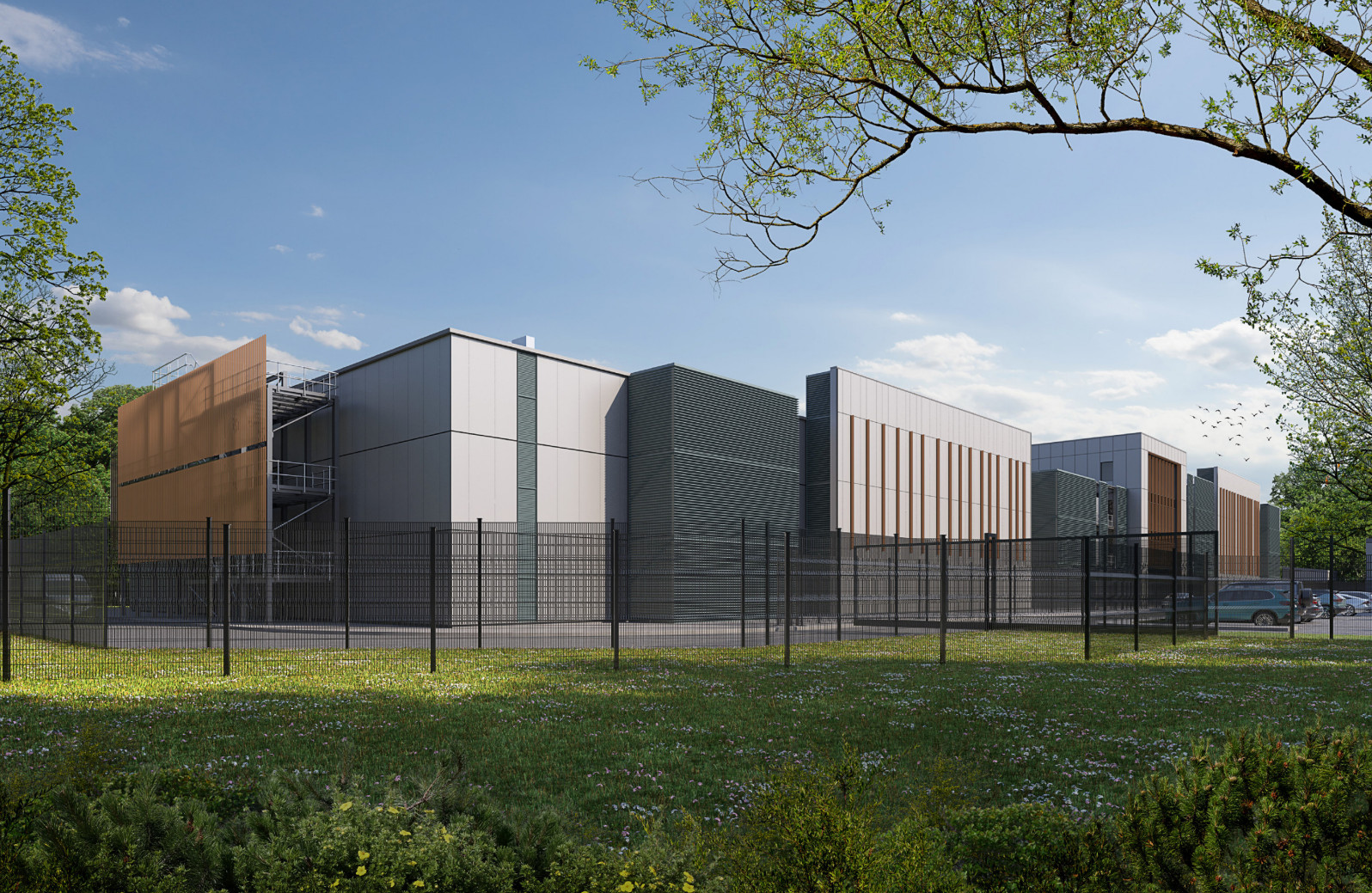
Illustration of the front elevation of the proposed new P6 building
NOISE
How is noise managed on the site?
Since 2005, Ark has developed the Spring Park Campus in phases. With each phase of development, Ark have incorporated technological improvements.
These, often innovative improvements, have meant there has been no significant increase in noise levels surrounding the site since Ark started monitoring background noise levels in 2016.
Sweco (Ark’s specialist acoustic and noise consultants) has reviewed the historic and latest baseline environmental sound surveys undertaken at the three closest noise sensitive receptor locations around the Spring Park Data Centre Campus.
The conclusion arising from the above comparisons is that there no increase in noise levels in the surrounding area that would be considered significant or are likely to affect the noise sensitive receptors in the area.
As part of the P6 planning application a comprehensive Noise Impact Assessment has been carried out. The outcome of the assessment shows that under normal operations, noise levels are expected to be below typical background levels in the area.
An assessment on the noise impact on bats has also been undertaken and this suggests that the bats in the area will not be affected by the noise from the proposed site.
Ark’s data centres have not caused a significant change to background noise levels in the surrounding areas. This is despite more than doubling the operational data centre capacity at Spring Park in the last 8 years. This demonstrates the effectiveness of the mitigation measures Ark’s design team have designed and employed over the period.
There is no reason to believe that the continued development of noise mitigation measures on future facilities will be any less effective than in the past.
In this light, all of Ark’s and Sweco’s noise assessment work shows that the P6 noise levels will be below typical background levels in the surrounding area is very clear and reasonable.
Key technical references:
Noise – response to impact assessment
Low Frequency Noise (LFN) Annoyance
Environmental Control and Protection – Planning Consultation Response
LIGHTING
Given the location, how is building and associated lighting managed?
The lighting control strategy on the existing campus is to turn off all external lights at night (apart from those required for maintenance or emergency exits and site safety). Ark will continue to use this strategy at the P6 Data Centre.
In addition, the design team for the proposed P6 Data Centre has specified that all external emergency lights are to be shrouded so that there is no light spill outside the data centre site.
Lighting plans submitted as part of the application show no light spill to the local area outside of the data centre security fence including the woodland.
Key technical reference:
DRAINAGE
How will drainage be managed for the new development?
Ark is aware of local concerns and Ark has worked closely with the Flood Authority (Wiltshire Council) to inform the detailed technical work.
Ark understands the concerns of residents due to the 2014 flood event. Following this event Ark connected the surface water drain from the adjacent MoD site to the new soakaway constructed for data centre P2 which has successfully absorbed all subsequent rain events.
As a result of the work arising from the 2014 flood event Ark has already reduced the flood risk to the proposed development site by diverting surface water drainage from the original, constrained, surface water drainage system down Westwells Road into a new soakaway on its land.
Since 2008, the surface water drainage strategy employed across the rest of the Spring Park campus is to attenuate all surface water collected on site and dispose of it via soakaways. This has been proven to work.
P6 Surface Water Drainage Strategy
The same strategy that is currently deployed across Spring Park is to be employed for the proposed development.
It is proposed that, as far as possible, all rainwater should be collected for re-use as part of the development’s cooling system.
Collected rainwater will be stored in below-ground attenuation tanks prior to passing through a filtration and treatment system, for use in the data centre’s cooling system.
For rainfall events in excess of the draw down rate of the data centre’s cooling system, (or if the rainwater harvesting tanks are full) the preferred option for discharge will be infiltration to the ground. This has been successfully carried out across the rest of the Spring Park Data Centre Campus.
As infiltration is proposed as the destination for surface water runoff not collected for reuse, there will be no requirement for discharge to the local stormwater drainage system.
Ark sees no reason for the drainage strategy to be less successful than the strategy already working for the whole Spring Park campus.
Key technical references:
Wiltshire Council’s response to drainage plan
AIR QUALITY
Will the new development affect local air quality?
Ark submitted a detailed Air Quality Assessment as part of the planning application to consider air quality impact during construction and testing of back-up generators.
Air quality impact during construction can be mitigated through the anticipated Construction Management Plan and Dust Management Plan.
It is important that data centres have resilient measures to ensure power supply and therefore on-site back-up generators are required in the case of very infrequent grid failures. These are also tested from time to time. The assessment shows that if the generators are required in an emergency for alternative power supply, the impact on air quality would not be significant.
Key technical reference:
ECOLOGY
How has ecology been considered?
Ark has consulted with both the Council’s ecology team and Natural England. Ark is required to achieve a 10% Biodiversity Net Gain (BNG) and, to help achieve this, Ark has proposed that the remainder of its land adjacent to P6 will be used for nature enhancements (with improved public access).
The development will deliver a varied landscaping scheme through the creation of neutral grassland and scrub. It will also re-instate an historic pond, together with standard tree planting across the site.
This approach, in tandem with entering into an agreement with the Environment Bank through offsite credits will allow Ark to meet the BNG requirements. This is a financial contribution to a third party to deliver the BNG in an identified offsite location within Wiltshire – an approach accepted by national planning policy and not unusual.
The impact on bats has been assessed by the Tyler Grange Group – an experienced firm of ecologists. They have carried out a series of surveys across the site and with the landscaping scheme, new lighting scheme and a construction and environment management plan, and have concluded the effects on bats will not be significant. Tyler Grange Group has also advised that there will be benefits to the bat species present from the proposed on site habitat creation.
Key technical references:
Governance and enforcement of habitat banks (setting out methodology)
BUILDING DESIGN
Are there images showing how the new building will look?
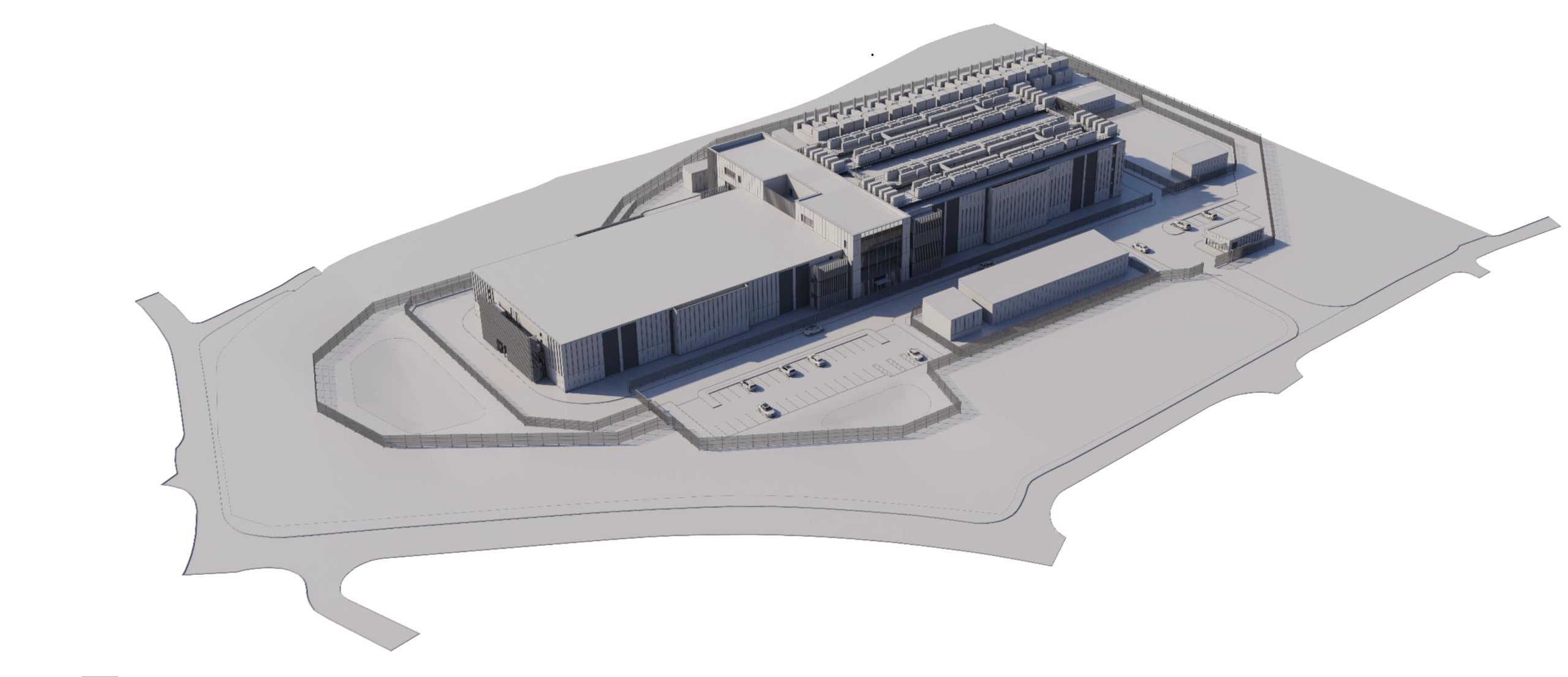
The following images show how the P6 building would look post-construction. We have shown the building from several viewpoints (as required for planning purposes). Development is only proposed on land that is considered as previously developed (“brownfield”).
Working with the architects, the position of the proposed data centre and ancillary buildings has been focused to the west of the site, so it moves away from the residential area to the east.
In terms of height, Ark has lowered the eastern half of the data centre which will be three stories rather than four. The building is set back from the road which will further minimise the effects of the data centre and will eliminate sight lines to roof top plant located on the western most end of the building.
Ark proposes to retain and strengthen boundary landscaping, including the planting of mature trees to form a visual screen.
Key technical references:
To read our FAQs, please use the button below.

Get in touch
If you have any questions, you can: